
What Is Local SEO for Businesses in Nigeria?
Local SEO is the process of improving your business’s visibility when people search online for products or services in a particular location.
For example, someone in Port Harcourt may search for “best restaurant in Port Harcourt,” “plumber near me,” “digital marketing agency in Lagos,” or “hotel in Abuja.” These searches have local intent because the person is looking for a business they can visit, contact, or use within a specific area.
For Nigerian businesses, local SEO can help connect your business with people searching for what you offer in your city, state, neighbourhood, or service area.
Google explains that local search results are primarily influenced by relevance, distance, and prominence. Complete and accurate business information can therefore help Google understand which businesses are relevant to a particular search.
This guide explains how local SEO works in Nigeria, what keywords to target, how to optimize your Google Business Profile, how to use your website for local search, and how to build trust without relying on keyword stuffing.
Why Local SEO Matters for Nigerian Businesses
Nigeria has a large and growing digital audience. DataReportal’s Digital 2026 Nigeria report states that there were approximately 109 million internet users in Nigeria in October 2025, representing 45.5% internet penetration at that time.
That means millions of potential customers can discover businesses through search engines, Google Maps, websites, social platforms, and other online channels.
Local SEO is particularly useful because it focuses on people who are searching with a location or immediate need.
Consider the difference between: “air conditioner repair” and “air conditioner repair in Ikeja.”
The second search gives Google a much clearer indication of the searcher’s local requirement. Local SEO helps businesses make that connection. It can be useful for:
- Restaurants and food businesses
- Hotels and guest houses
- Hospitals and clinics
- Salons and barbers
- Real estate businesses
- Lawyers and accountants
- Schools and training centres
- Auto repair shops
- Cleaning companies
- Plumbers and electricians
- Construction companies
- Digital marketing agencies
- Retail stores
- Event businesses
- Photographers
- Delivery businesses
- Professional service providers
If customers need to visit you or you travel to serve them, local SEO should be part of your digital marketing strategy.
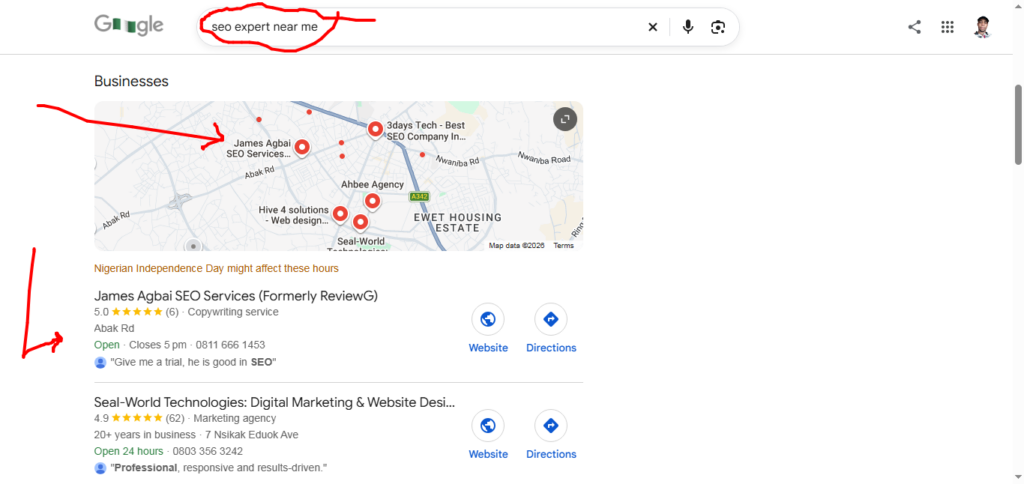
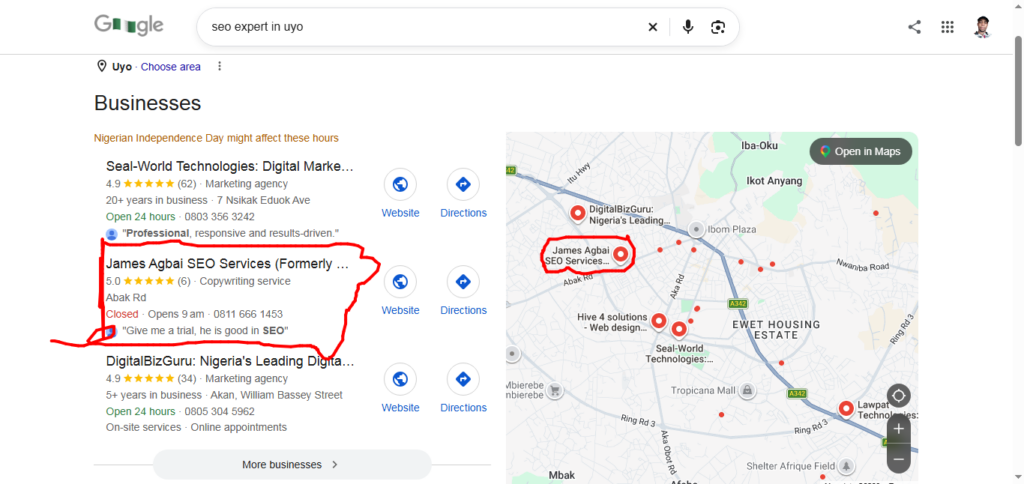
First-hand example: Ranking an SEO business for local searches in Uyo
I used my own business as a practical test of local SEO. I targeted searches related to SEO services in Uyo and monitored the Google local results after optimizing the business profile, website and supporting local signals.
The screenshot below records the result on 1 October, 2026. Because Google local results can vary according to factors including relevance, distance and prominence, this should be treated as a snapshot of visibility rather than a permanent ranking guarantee.
What this example demonstrates:
- The business was targeting a specific local market.
- The search was connected to a real service and location.
- The result was observed in Google’s local search environment.
- The ranking should be viewed as a point-in-time result, not a guarantee of future rankings.
Understanding Local Search Intent
Before choosing local SEO keywords, you need to understand search intent. Search intent simply means the reason behind a person’s search. For local businesses, there are four important types of intent.
1. Informational Local Intent
The person wants information. Examples include:
- “how to register a business in Nigeria”
- “how much does a wedding photographer cost in Lagos”
- “best areas to stay in Abuja”
- “how to choose a plumber in Port Harcourt”
These searches may not immediately lead to a sale, but useful content can introduce your business to potential customers.
2. Commercial Investigation Intent
The person is researching businesses before making a decision. Examples:
- “best digital marketing agency in Lagos”
- “SEO companies in Nigeria”
- “best hotels in Abuja”
- “accounting firms in Port Harcourt”
These searches often indicate that the customer is comparing options. Your website should therefore explain your services clearly, demonstrate expertise, provide useful evidence, and make it easy for visitors to contact you.
3. Transactional Intent
The person is ready to take action. Examples:
- “book hotel in Lagos”
- “buy furniture in Abuja”
- “hire a plumber in Lekki”
- “restaurant near me”
- “SEO agency near me”
These keywords can be highly valuable because the searcher may already know what they want.
4. Navigational Intent
The person is trying to find a particular business. Examples:
- “ABC Pharmacy Lagos”
- “Company Name Port Harcourt”
- “Business Name Google Maps”
Your business name, website, Google Business Profile, contact information, and other online references should be consistent so customers can find the correct business.
Local SEO Keyword Research for Nigeria
Keyword research is one of the foundations of local SEO. Instead of targeting only broad keywords, think about what your customers would actually type into Google. A simple local keyword formula is Service + Location
For example:
- plumber + Lagos
- restaurant + Abuja
- lawyer + Port Harcourt
- photographer + Enugu
- hotel + Ibadan
You can also combine your service with words such as:
- near me
- best
- affordable
- professional
- company
- services
- agency
- shop
- open now
- in [location]
For example: “SEO services in Nigeria” “digital marketing agency in Lagos” “professional photographer in Abuja” car repair shop in Port Harcourt”
Do not force every variation into one page. The goal is to understand how customers search and create useful pages that naturally answer those searches.
Use Location-Specific Keywords Naturally
Local businesses sometimes make the mistake of repeating a city name dozens of times on a page.
This is called keyword stuffing, and it usually creates a poor reading experience.
Instead, use locations naturally.
For example, a Lagos-based cleaning company could have a page titled: Professional Cleaning Services in Lagos
The page could naturally discuss the areas served, types of cleaning provided, response times, service process, frequently asked questions, and how customers can request a quotation.
You can mention relevant areas where genuinely served, such as Ikeja, Lekki, Victoria Island, Yaba, Surulere, or other locations.
The important point is accuracy.
Do not claim to serve an area simply because you want to rank there.
Not sure whether your Google Business Profile is properly optimized?
Get a local SEO audit covering your Google Business Profile, website, local keywords, citations and conversion opportunities.
Google Business Profile for Nigerian Businesses
A Google Business Profile is one of the most important tools for local search.
Google says businesses can use a Business Profile to manage how their business appears on Google Search and Google Maps. It can include information such as business hours, website, phone number, location, photos, videos, and reviews.
For eligible Nigerian businesses, your profile should be complete and accurate.
Important information includes:
- Correct business name
- Appropriate primary category
- Accurate address or service area
- Business hours
- Website
- Phone number
- Relevant photos
- Services
- Business description
- Customer reviews
Google recommends using the fewest appropriate categories necessary to describe the core business rather than selecting categories simply as keywords.
Keep Your Business Information Consistent
Your business name, address, phone number, website, and other important details should be consistent across your online presence.
For example, if your website says your business is located in a particular area but your Google Business Profile contains a different address, customers may become confused.
Google states that business information can come from multiple sources, including the business itself, websites, third-party data, and user contributions.
Accurate information therefore matters beyond your website alone.
How to Rank on Google Maps in Nigeria
There is no legitimate shortcut that guarantees a number-one position on Google Maps.
Google states that local results are mainly based on relevance, distance, and prominence, and that businesses cannot pay Google to receive a better organic local ranking.
Instead of looking for shortcuts, focus on making your business information useful and trustworthy. Start with these steps:
- Claim and verify your Google Business Profile.
- Use accurate business information.
- Select the most relevant business category.
- Add useful services and business details.
- Upload genuine photographs.
- Keep opening hours updated.
- Encourage genuine customers to leave reviews.
- Respond professionally to reviews.
- Build a useful website.
- Earn relevant mentions and links from reputable websites.
Google also advises businesses to keep their profile information complete and up to date.
Reviews and Local SEO
Reviews are important for both customers and local businesses. A person searching for a restaurant, hotel, clinic, mechanic, or service provider may look at reviews before deciding whom to contact.
Ask genuine customers for honest feedback after providing your service. Do not buy fake reviews or create misleading testimonials.
When customers leave reviews, respond professionally. Thank customers for positive feedback and address legitimate complaints calmly. Google specifically recommends responding to reviews and notes that helpful responses can help a business stand out.
A negative review does not automatically mean your business has failed. What matters is how you handle the situation and whether your response demonstrates professionalism.
Build a Local SEO-Friendly Website
Your Google Business Profile is important, but your website remains a valuable part of your local SEO strategy.
Your website should clearly answer five basic questions:
Who are you?
What do you offer?
Where do you operate?
Why should customers trust you?
How can customers contact you?
For example, a local plumbing company could create pages such as:
- Plumbing Services
- Plumbing Services in Lagos
- Emergency Plumbing
- Bathroom Plumbing
- Commercial Plumbing
- About the Company
- Contact
- Frequently Asked Questions
Do not create dozens of nearly identical location pages simply by replacing one city name with another. Each useful location page should contain genuinely helpful information about that area and the service available there.
Create Helpful Local Content
Content marketing and local SEO work well together. Create articles that answer questions your customers actually ask. For example, a Nigerian real estate company might publish:
- How to Rent an Apartment in Lagos
- What to Check Before Renting a House in Abuja
- Guide to Property Viewing in Nigeria
- Questions to Ask Before Buying Property
- Cost of Renting in Different Lagos Areas
A restaurant could publish:
- Popular Nigerian Dishes to Try
- Guide to Choosing a Restaurant for a Business Meeting
- How to Plan a Dinner Event
- Best Foods for a Nigerian Wedding Reception
The purpose is not simply to insert keywords. The purpose is to become a useful source of information for your target customers.
That approach also supports GEO, or Generative Engine Optimization, because AI-powered search experiences increasingly need clear, reliable information that can be understood and referenced.
Local SEO and GEO: What Nigerian Businesses Should Know
GEO can be understood as optimizing your online presence so that AI-powered search and answer systems can better understand your business, expertise, services, and relevance.
Traditional SEO focuses heavily on appearing in search results. GEO also considers whether your business information is clear enough for AI systems to understand and use when answering questions.
For Nigerian businesses, this means providing consistent, factual information across your:
- Website
- Google Business Profile
- Service pages
- About page
- Author pages
- Business directories
- Industry websites
- Local publications
- Reviews
- Social profiles
For example, instead of writing: “We are the best company in Nigeria.” provide evidence-based information: “We provide commercial cleaning services for offices, retail spaces, and hospitality businesses in Lagos.”
Then explain your process, experience, service areas, qualifications, and customer experience. Specific information is more useful than unsupported claims.
E-E-A-T for Local SEO
E-E-A-T stands for:
Experience
Expertise
Authoritativeness
Trustworthiness
For local businesses, these principles can be demonstrated through your website and real-world business information.
Experience
Show that your business understands the problems customers face.
You can discuss real projects, processes, lessons learned, or practical advice.
Expertise
Explain your services accurately.
Where relevant, identify qualified professionals, certifications, licences, training, or industry experience.
Authoritativeness
Build recognition through legitimate business relationships, relevant publications, professional organisations, community involvement, and reputable mentions.
Trustworthiness
Make it easy for customers to verify who you are. Provide accurate contact information, business details, policies, clear pricing information where appropriate, and genuine customer feedback. Avoid exaggerated claims that cannot be supported.
Local Citations and Business Directories
A local citation is a mention of your business online. It may include your:
- Business name
- Address
- Phone number
- Website
- Business category
Relevant directories, industry websites, chambers of commerce, professional associations, local publications, and reputable Nigerian business platforms can provide useful references.
However, quality matters more than collecting hundreds of random directory listings. Avoid submitting your business to low-quality websites simply to create backlinks. Instead, focus on websites that are relevant to your industry, location, or customers.
Local Link Building in Nigeria
Links from other websites can help people discover your business and can contribute to your website’s authority. Local link opportunities may include:
- Nigerian business publications
- Industry associations
- Local news websites
- Professional organisations
- Community organisations
- Business partnerships
- Relevant event websites
- Universities and educational organisations
- Local directories
For example, a Nigerian event planning company could potentially earn a relevant mention from an event venue, industry publication, wedding directory, or local event organisation. The strongest approach is to create something genuinely useful that another website has a reason to reference.
Common Local SEO Mistakes Nigerian Businesses Should Avoid
1. Creating fake business locations
Do not create fake offices simply to target more cities. Google’s guidelines require businesses to accurately represent their real-world location or service area.
2. Keyword stuffing
Repeating phrases such as “best plumber in Lagos” unnaturally throughout a page can make the content difficult to read. Write for people first.
3. Buying fake reviews
Fake reviews can damage customer trust and create policy problems. Build your reputation through genuine customer experiences.
4. Using inaccurate business information
Incorrect addresses, hours, phone numbers, or service areas can frustrate customers. Keep your information updated.
5. Creating thin location pages
Changing “Lagos” to “Abuja” on the same page does not create genuinely useful local content. Each page should serve a real purpose.
6. Ignoring mobile users
Many customers discover businesses using mobile devices. Your website should therefore load properly and be easy to navigate on smartphones.
7. Publishing AI-generated content without checking it
AI can assist with content creation, but businesses should review information for accuracy, originality, relevance, and local context. Your content should demonstrate genuine knowledge rather than simply producing large volumes of generic text.
Local SEO Checklist for Nigerian Businesses
Use this checklist as a simple starting point:
- Claim your Google Business Profile.
- Verify the profile where required.
- Use your real business name.
- Select the most relevant business category.
- Add accurate contact information.
- Add your correct address or service area.
- Set accurate opening hours.
- Add your website.
- Upload genuine business photographs.
- Add relevant services.
- Ask genuine customers for reviews.
- Respond to reviews professionally.
- Build a mobile-friendly website.
- Create service pages.
- Create useful location pages where appropriate.
- Publish helpful local content.
- Keep business information consistent online.
- Build relevant local citations.
- Earn quality local links.
- Monitor your Google Search and Maps visibility.
- Update outdated information regularly.
Want help implementing this checklist?
I help Nigerian businesses improve their local search visibility and turn search traffic into enquiries.
How Long Does Local SEO Take in Nigeria?
Local SEO is not normally an overnight marketing strategy. The time required to see meaningful results can vary depending on factors such as your industry, competition, location, website quality, existing online reputation, business prominence, and the quality of your optimization.
A new business competing in a highly competitive market may need more time and effort than an established business with a strong reputation and relevant online mentions.
Rather than expecting a guaranteed ranking within a specific number of days, measure progress using practical indicators such as:
- Search impressions
- Website visits
- Phone calls
- Direction requests
- Contact form submissions
- Enquiries
- Bookings
- Customer reviews
- Organic traffic
- Local keyword visibility
How to Measure Local SEO Success
Ranking number one should not be the only measurement of success. A business can receive search visibility without generating meaningful customers. Instead, connect local SEO with business outcomes.
For example:
Visibility → Website visit → Enquiry → Customer → Revenue
Track where possible:
- Google Business Profile interactions
- Website traffic from local searches
- Calls
- WhatsApp or contact enquiries
- Form submissions
- Booking requests
- Store visits where measurable
- Sales generated from organic search
This gives you a clearer understanding of whether your local SEO investment is contributing to the business.
Final Thoughts on Local SEO for Businesses in Nigeria
Local SEO gives Nigerian businesses a practical way to become easier to discover when potential customers search for products and services in their area.
The foundation is straightforward: provide accurate information, understand local search intent, optimize your Google Business Profile, create useful website content, build genuine credibility, and make it easy for customers to contact you.
Do not treat local SEO as a trick for manipulating Google. Treat it as a way of making your business easier to understand, easier to verify, and easier to find.
For Nigerian businesses, that means using real locations, accurate service areas, relevant keywords, useful content, genuine reviews, trustworthy business information, and a website that answers customer questions.
Google’s own guidance emphasizes accurate business information, appropriate categories, reviews, photos, and other profile details while identifying relevance, distance, and prominence as key aspects of local ranking.
When these elements work together, your business has a stronger foundation for local search visibility in Nigeria.
In simple terms: local SEO is about being visible to the right people, in the right place, when they are looking for what your business provides.
Frequently Asked Questions About Local SEO in Nigeria
What is local SEO in Nigeria?
Local SEO in Nigeria is the process of improving a business’s online visibility for searches connected to a specific Nigerian city, state, neighbourhood, or service area.
Is Google Business Profile important for local SEO?
Yes. For eligible businesses, a Google Business Profile allows customers to find useful business information on Google Search and Google Maps.
How do I rank my business on Google Maps in Nigeria?
Start with accurate and complete business information, the correct business category, genuine reviews, useful photos, a strong website, relevant local content, and legitimate online mentions. Google states that local rankings are primarily based on relevance, distance, and prominence.
Can a service-area business use Google Business Profile?
Eligible service-area businesses can use a Business Profile, provided they meet Google’s requirements. Businesses should accurately represent their service area rather than creating misleading locations.
Should I create a separate page for every Nigerian city?
Not necessarily. Create location pages when you genuinely serve those locations and can provide useful, unique information. Avoid producing large numbers of near-identical pages with only the city name changed.
What keywords should Nigerian businesses target?
Start with keywords combining your service and location, such as “lawyer in Lagos,” “hotel in Abuja,” “plumber in Port Harcourt,” or “digital marketing agency in Nigeria.” Then expand into customer questions, commercial searches, and service-specific terms.
Is local SEO only for businesses with physical shops?
No. Eligible service-area businesses that travel to customers can also benefit from local SEO. Google provides specific guidelines for businesses that serve customers at their locations.
What is the difference between SEO and local SEO?
SEO generally focuses on improving visibility in search engines, while local SEO focuses specifically on searches connected to a geographical area and local businesses.
Is local SEO worth doing for a small business in Nigeria?
Local SEO can be particularly relevant when customers search for businesses, services, or products within a specific location. Its value depends on the business, target customers, competition, and quality of execution.
What is the most important first step in local SEO?
Start by making sure your business information is accurate and that your Google Business Profile and website clearly communicate what you offer and where you serve customers. Then build from there with useful content, reviews, and legitimate local authority.
Ready to improve your local visibility?
If customers are searching for your services in Lagos, Abuja, Port Harcourt, Onitsha or elsewhere in Nigeria, I can audit your current local SEO setup and identify the biggest opportunities.
Author Profile

-
James Agbai is an SEO Specialist and Content Strategist with over five years of experience helping businesses, bloggers, startups, and service providers improve their online visibility through ethical, data-driven SEO.
He specializes in technical SEO, content strategy, keyword research, and on-page optimization, with a focus on building sustainable organic growth rather than relying on short-term tactics.
Latest entries
 CONTENT SEOOctober 22, 2026Why Your Blog Posts Are Not Ranking on Google: 15 Reasons and How to Fix Them
 CONTENT SEOOctober 22, 2026How to Build an SEO Topic Cluster (Step-by-Step Guide)
 CONTENT SEOOctober 17, 2026SEO Content Strategy for Nigerian Businesses: A Complete Guide to Getting Found on Google
 TECHNICAL SEOOctober 17, 2026How to Fix 404 Errors in WordPress: A Complete Step-by-Step Guide