
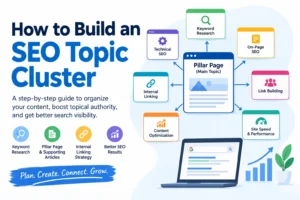
Search engine optimization (SEO) is not just about choosing the right keywords and publishing blog posts. It is also about organizing your website so readers and search engines can easily understand what you cover and how your content connects.
One effective way to do this is by building an SEO topic cluster. Instead of publishing unrelated articles, you create a central, comprehensive guide supported by several focused articles that explore specific aspects of the same subject.
For example, a website about digital marketing might publish a main guide to SEO and support it with articles about keyword research, on-page SEO, technical SEO, internal linking, and content optimization.
Each article answers a different question, while internal links connect the pages into one organized content structure.
In this guide, you will learn how to build an SEO topic cluster from scratch, choose the right keywords, create a pillar page, organize supporting articles, and measure your results. Whether you are a beginner, blogger, business owner, or content marketer, you can use this approach to build a more useful website and improve your chances of attracting relevant organic traffic.
What Is an SEO Topic Cluster?
An SEO topic cluster is a group of related website pages organized around one main subject. It typically consists of a central pillar page, several supporting articles, and internal links connecting them.
Think of it as a book with chapters. The main guide introduces the subject, while each supporting article explains one part in greater detail. A topic cluster usually has three essential components. Also read on SEO Content Strategy for Nigerian Businesses: A Complete Guide to Getting Found on Google
1. The pillar page
A pillar page is a comprehensive guide that introduces a broad topic and explains its most important subtopics. It provides readers with a useful overview and directs them to more detailed articles when necessary.
For example, a pillar page titled “The Complete Guide to Search Engine Optimization” might cover keyword research, content optimization, technical SEO, backlinks, and performance tracking.
The page should answer the main question thoroughly without attempting to explain every subtopic in exhaustive detail.
2. Supporting articles
Supporting articles, sometimes called cluster content, focus on specific questions related to the main subject.
For an SEO pillar page, supporting articles might include:
- How to conduct keyword research.
- How to optimize a blog post for SEO.
- How to improve website loading speed.
- How to build quality backlinks.
- How to create an internal linking strategy.
Each article serves a distinct purpose and provides information that deserves its own dedicated page.
3. Internal links
Internal links connect pages on the same website. They help readers discover related information and help search engines find and understand the relationship between your pages.
Your pillar page should link to relevant supporting articles. Each supporting article should also link back to the pillar page when it helps readers understand the broader subject.
When appropriate, related supporting articles can link to one another.
Together, these three components create a connected content structure rather than a collection of isolated blog posts.
Why Are Topic Clusters Important for SEO?
Topic clusters help you organize your content around the questions your audience wants answered. Although using a topic cluster does not guarantee higher rankings, it supports several sound SEO practices.
They improve website organization
When your content follows a logical structure, readers can move from a general introduction to a more detailed explanation without repeatedly searching for information.
For instance, someone reading about keyword research can easily discover a related guide about search intent or keyword difficulty.
This creates a more helpful browsing experience.
They support internal linking
Internal links help search engines discover pages and understand their context. A well-organized cluster makes it easier to connect relevant articles naturally.
Instead of leaving new posts buried in your blog archive, you can link to them from established, relevant pages.
They help you cover a subject comprehensively
Writing about related subtopics encourages you to answer more of the questions your audience may have.
This can strengthen your website’s usefulness and demonstrate subject knowledge when the content is accurate, original, and genuinely helpful.
They reduce unnecessary content duplication
Without a clear plan, you might publish several articles that answer essentially the same question.
For example, “SEO Keyword Research Guide” and “How to Find Keywords for SEO” may overlap significantly.
A topic cluster helps you decide whether similar phrases belong on one page or whether a genuinely different question deserves its own article.
They can support visibility in AI-powered search
Generative Engine Optimization (GEO) involves improving content so that AI-powered search experiences can understand, use, and potentially reference it in their responses.
Clearly organized articles, direct answers, descriptive headings, credible sources, and consistent explanations can make information easier to interpret.
However, topic clusters do not guarantee citations in AI-generated answers. Your content must still provide useful information, be accessible, and demonstrate reliability.
How to Build an SEO Topic Cluster Step by Step
Building a topic cluster does not require an expensive SEO tool or a large content team. You can start with a spreadsheet, a clear audience, and a subject you understand.
Follow these steps to develop your first cluster.
Step 1: Choose a Main Topic
Begin by identifying a broad subject that matters to your audience and aligns with the purpose of your website.
The topic should be broad enough to support several useful articles but focused enough to fit your website’s expertise.
For example, a personal finance website might choose budgeting, while a gardening website might focus on growing vegetables at home.
A digital marketing website could select search engine optimization as its main topic.
Before committing to a topic, ask yourself three questions:
- Does my audience need information about this subject?
- Can I provide accurate and useful guidance on it?
- Are there enough distinct questions to support several articles?
Your answers will help you avoid choosing a topic simply because it sounds popular.
Tip: Start with one main subject rather than trying to build clusters across every category on your website at once.
Step 2: Identify Your Main Keyword
Once you have selected your topic, choose a primary keyword for the pillar page.
A primary keyword is the main search phrase you want the page to address. It should describe the page’s central purpose clearly.
For example, if your topic is SEO topic clusters, potential keywords include:
- SEO topic clusters.
- How to build an SEO topic cluster.
- Topic cluster strategy.
- Pillar pages and supporting content.
Use keyword research tools to explore related searches, estimated search demand, and competition. Depending on your budget, you can use Google Keyword Planner, Google Search Console, or suitable SEO research tools.
Do not rely on search volume alone. A keyword with fewer searches may be more valuable if it closely matches your audience’s needs.
You should also examine the current search results. Look at the types of pages appearing for your target phrase, the questions they answer, and the information they leave unclear.
This helps you understand what searchers expect before you begin writing.
Step 3: Understand Search Intent
Search intent is the reason someone enters a query into a search engine.
Understanding it helps you create the right type of page for your audience.
The four common categories are:
Informational intent: The searcher wants to learn something. For example, “What is a topic cluster?”
Navigational intent: The searcher wants to find a particular website or page. For example, searching for a specific SEO tool’s login page.
Commercial investigation: The searcher is comparing options before making a decision. For example, “Best keyword research tools for bloggers.”
Transactional intent: The searcher is ready to take an action, such as purchasing an SEO subscription.
For the keyword “How to Build an SEO Topic Cluster,” informational intent is the primary focus. The reader wants instructions, examples, and a practical process.
Your pillar page should therefore teach the process rather than immediately pushing a product or service.
Each supporting article should also match its own search intent. A guide to keyword research should teach people how to research keywords, while a comparison of keyword research tools should help readers evaluate their options.
Matching intent makes your content more useful and helps prevent pages from competing unnecessarily.
Step 4: Find Related Keywords and Subtopics
Now expand your main topic into smaller questions and themes.
Start by brainstorming what a beginner would need to understand before becoming comfortable with the subject.
You can also examine autocomplete suggestions, related searches, customer questions, relevant online discussions, and questions that appear in search results.
For an SEO topic cluster, related keywords might include:
- What is an SEO topic cluster?
- How to create a pillar page.
- How to do keyword clustering.
- How to find supporting keywords.
- How to build internal links.
- How to avoid keyword cannibalization.
- How to measure topic cluster performance.
- How to optimize content for AI search.
Group similar phrases together according to the question they represent.
For example, “how to build internal links” and “internal linking best practices” might belong on one comprehensive article if the search results and reader needs substantially overlap.
However, a page comparing internal linking tools may deserve a separate article because its purpose is different.
Important: Do not create a separate page for every keyword variation. Create separate pages when there is enough distinct value and a different informational need to justify them.
Step 5: Create a Topic Cluster Map
A topic cluster map is a simple plan showing your pillar page, supporting articles, target keywords, and intended internal links.
You can create one in a spreadsheet before writing anything.
Here is an example of a topic cluster for SEO beginners.
| Page type | Target keyword | Main purpose |
|---|---|---|
| Pillar page | SEO guide for beginners | Explain the fundamentals of SEO |
| Supporting article | Keyword research guide | Teach readers how to find keywords |
| Supporting article | Search intent in SEO | Explain why people search |
| Supporting article | On-page SEO checklist | Show how to optimize individual pages |
| Supporting article | Technical SEO basics | Explain crawling, indexing, and site health |
| Supporting article | Internal linking strategy | Teach readers how to connect pages |
| Supporting article | Link building for beginners | Explain ways to earn relevant backlinks |
| Supporting article | SEO performance tracking | Show how to measure progress |
The pillar page provides the overall framework, while the supporting articles explore specific tasks.
Notice that each supporting article has a clear purpose. This helps you avoid publishing multiple pages that repeat the same information.
Your map can also include proposed URLs, publication dates, content status, and the pages each article should link to.
Step 6: Create a Useful Pillar Page
Your pillar page should be comprehensive enough to answer the main question while remaining easy to navigate.
Begin with a clear introduction that explains what the reader will learn. Provide a direct definition of the topic, then organize the rest of the article into logical sections.
Use descriptive headings, short paragraphs, relevant examples, and practical instructions.
For example, a pillar page about SEO topic clusters could include sections on:
- What topic clusters are.
- Why they matter.
- How to choose a main topic.
- How to research and group keywords.
- How to plan supporting articles.
- How to connect pages with internal links.
- How to measure results.
- Common mistakes and frequently asked questions.
Add links to supporting articles within the sections where they are most useful.
If a detailed supporting article is not published yet, note it in your editorial plan and add the link when the article becomes available.
Do not stretch an article simply to reach a particular word count. A 2,000-word guide can be a useful pillar page, but its value depends on the quality and completeness of the information, not the number of words alone.
Step 7: Write Supporting Articles
Each supporting article should answer one focused question thoroughly.
Avoid treating these articles as short summaries created solely to link back to the pillar page. Every article should provide standalone value to someone who lands on it directly from Google or another source.
For example, an article about keyword research should explain how to identify seed keywords, evaluate search intent, compare keyword opportunities, and organize the findings.
It should also provide examples that readers can follow.
When useful, link to your main SEO guide to help readers understand how keyword research fits into a wider strategy.
Similarly, your internal linking article can link back to the pillar page and connect to related articles about website structure and on-page SEO.
This creates a useful journey between pages without forcing readers to follow a predetermined path.
Step 8: Add Relevant Internal Links
Internal linking is the connection that holds a topic cluster together.
Start by linking from your pillar page to each relevant supporting article. Then add a contextual link from every supporting article back to the pillar page.
Link related supporting articles to one another when the connection is genuinely useful.
Use descriptive anchor text, which is the clickable text in a hyperlink.
For example, instead of writing “Click here to learn more,” write “Follow this keyword research guide to identify relevant search terms.”
The second example tells readers what to expect from the linked page.
Keep links natural and relevant to the surrounding paragraph. There is no universal number of internal links that every article needs.
Your goal is to make important content easy to discover, not to insert links into every sentence.
Also, make sure each important page can be reached through at least one crawlable internal link. A page that has no meaningful internal links pointing to it may be harder for visitors and search engines to discover.
Step 9: Optimize Your Content for GEO and E-E-A-T
Modern content strategies should consider both traditional search engines and AI-powered discovery experiences.
GEO focuses on making content clear and useful for systems that generate answers from information found across the web.
E-E-A-T stands for Experience, Expertise, Authoritativeness, and Trustworthiness. Google uses these concepts in its quality evaluation framework, although E-E-A-T itself is not a single direct ranking factor.
You can strengthen your content’s credibility through practical measures.
Demonstrate experience. Include genuine examples, original observations, screenshots, or lessons from work you have actually completed.
Show expertise. Explain concepts accurately, use appropriate terminology, and provide enough detail for readers to understand the process.
Build authoritativeness. Publish consistently useful content within your area of focus and provide accurate author biographies and relevant credentials.
Establish trust. Cite reliable sources, correct errors, disclose commercial relationships where applicable, and keep important information up to date.
For GEO, make your writing easy to interpret. Answer the main question early, use meaningful headings, define unfamiliar terms, and provide concise explanations before exploring more complex details.
Use tables, examples, and FAQs where they genuinely improve understanding.
Structured data may help search engines interpret eligible page information, but it does not guarantee enhanced search appearances or AI citations.
Above all, create content for people. Neither keyword repetition nor publishing large numbers of similar AI-generated articles is a substitute for useful, original information.
Step 10: Measure and Improve Your Topic Cluster
Publishing your content is only the beginning. You also need to monitor how readers find and use it.
Google Search Console is a useful starting point because it shows information about your website’s performance in Google Search.
Review the following metrics:
Impressions: How often your pages appear in search results.
Clicks: How many visits your pages receive from search results.
Click-through rate: The percentage of impressions that result in clicks.
Average position: Your pages’ average ranking position for reported searches.
You can also use website analytics to monitor organic sessions, engaged visits, conversions, and other goals relevant to your website.
Evaluate performance across the entire cluster, not just the pillar page. A supporting article may attract visitors through a specific long-tail keyword even when the main guide receives fewer clicks.
Look for pages with impressions but relatively few clicks, articles that receive little search visibility, and related pages that may be competing for the same queries.
Update outdated information, improve weak sections, add missing internal links, and combine overlapping articles when doing so creates a better resource.
Give new content enough time to be discovered and assessed. SEO results vary depending on competition, site history, content quality, and other factors, so avoid promising a particular ranking or timeline.
Need Help Building Your Content Strategy?
If your website has useful content but lacks a clear structure, a focused SEO review can help identify content gaps, overlapping pages, and internal-linking opportunities.
Common SEO Topic Cluster Mistakes to Avoid
Even a well-planned cluster can underperform if its content is poorly organized.
Targeting the same search intent on multiple pages
Publishing several articles that answer the same question can create unnecessary overlap.
Review your existing content before creating new pages. Combine articles when one stronger page would serve readers better.
Choosing topics unrelated to your audience
A popular keyword is not automatically a good choice.
Focus on subjects that support your website’s purpose and provide meaningful value to your intended readers.
Overusing keywords in headings and links
Repeatedly inserting exact-match keywords can make content sound unnatural.
Use clear language, natural variations, and descriptive anchor text instead.
Publishing thin supporting articles
Supporting articles should answer their questions properly. A brief article that repeats the pillar page without offering additional value is unlikely to make the cluster more useful.
Forgetting to update existing content
Your topic cluster should develop as your website grows. Review older pages, correct outdated information, add links to relevant new articles, and remove unnecessary duplication.
Expecting guaranteed rankings
Topic clusters are an organizational and content strategy, not a shortcut that guarantees first-page rankings.
Their value depends on the quality of your content, the usefulness of your links, the competitiveness of your subject, and the overall experience your website provides.
Frequently Asked Questions About SEO Topic Clusters
How many articles should an SEO topic cluster have?
There is no fixed number. A small cluster might contain one pillar page and four or five supporting articles, while a broader subject may need many more.
Start with the questions your audience genuinely needs answered. Expand the cluster when you identify additional topics that deserve dedicated coverage.
What is the difference between a pillar page and a topic cluster?
A pillar page is the central guide covering a broad subject. A topic cluster is the complete structure, including the pillar page, supporting articles, and internal links connecting them.
In simple terms, the pillar page is one part of the cluster, not the entire cluster.
Do topic clusters improve Google rankings?
They can support good SEO by improving content organization, internal linking, and coverage of related subjects. However, Google does not guarantee higher rankings because a website uses a topic cluster structure.
Useful content, relevant links, technical accessibility, and satisfying the searcher’s needs remain important.
Are topic clusters useful for small blogs?
Yes. Small blogs can start with a single focused topic and a handful of well-researched supporting articles.
You do not need hundreds of pages to create a useful cluster. A smaller collection of accurate, relevant articles may be more valuable than a large collection of repetitive posts.
How long does it take to see results from a topic cluster?
There is no guaranteed timeframe. Search visibility depends on factors such as competition, website history, crawling and indexing, content quality, and how well the pages meet search intent.
Track impressions, clicks, and engagement over time, then improve the cluster based on actual performance.
Can AI help create an SEO topic cluster?
AI tools can help brainstorm subtopics, organize keyword lists, generate outlines, and identify potential content gaps.
However, review the output carefully. Verify factual claims, remove repetition, add genuine expertise, and make sure every article serves a distinct purpose.
AI assistance does not remove your responsibility to publish accurate, original, and useful content.
Author Profile

-
James Agbai is an SEO Specialist and Content Strategist with over five years of experience helping businesses, bloggers, startups, and service providers improve their online visibility through ethical, data-driven SEO.
He specializes in technical SEO, content strategy, keyword research, and on-page optimization, with a focus on building sustainable organic growth rather than relying on short-term tactics.
Latest entries
 CONTENT SEOOctober 22, 2026Why Your Blog Posts Are Not Ranking on Google: 15 Reasons and How to Fix Them
 CONTENT SEOOctober 22, 2026How to Build an SEO Topic Cluster (Step-by-Step Guide)
 CONTENT SEOOctober 17, 2026SEO Content Strategy for Nigerian Businesses: A Complete Guide to Getting Found on Google
 TECHNICAL SEOOctober 17, 2026How to Fix 404 Errors in WordPress: A Complete Step-by-Step Guide