
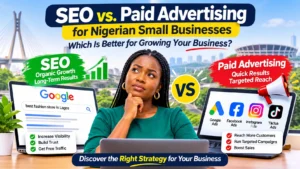
Running a small business in Nigeria comes with many challenges. Whether you operate a fashion business in Lagos, sell food in Abuja, run a beauty salon in Port Harcourt, offer professional services in Ibadan, or manage an online store from anywhere in the country, one thing remains important: getting customers.
Today, many customers search online before deciding where to buy a product or pay for a service. Someone looking for a reliable plumber may search Google. A person who wants to buy a phone may compare different online stores. Someone searching for a catering service may check websites, reviews and social media pages before making a decision.
This means having a good product or service is not always enough. People also need to find your business.
Two popular ways to attract customers online are Search Engine Optimisation (SEO) and paid advertising. Both can help Nigerian small businesses increase visibility, reach potential customers and generate sales. However, they work differently, require different levels of investment and produce different results.
So, when comparing SEO vs paid advertising for Nigerian small businesses, which strategy should you choose?
Should you invest in SEO to attract visitors from Google without paying for every click, or should you run paid advertisements to reach potential customers more quickly? The answer depends on your business goals, budget, competition and how quickly you need results.
In this guide, we will explain everything in simple language, compare the costs and benefits, and show you how to choose the right digital marketing strategy for your business in Nigeria.
What Is SEO?
SEO stands for Search Engine Optimisation. It is the process of improving your website and online content so that search engines such as Google can understand your business and show your pages to people searching for relevant information, products or services.
In simple terms, SEO helps people find your business when they search online. For example, imagine you own a bakery in Lekki, Lagos. Someone searches Google for “birthday cake delivery in Lekki”.
If your website has useful content, relevant information about your services, good technical performance and a strong local online presence, it may appear in the search results.
When the person clicks your website, you have an opportunity to turn that visitor into a customer. The important thing to understand is that SEO does not mean paying Google to place your website at the top of search results. It involves improving your online presence so that search engines can discover, understand and potentially rank your content.
How Does SEO Work?
SEO involves several activities that work together.
1. Keyword research
Keywords are the words and phrases people type into search engines. For example:
- Affordable wedding dresses in Lagos.
- Best hair salon in Abuja.
- Where to buy original laptops in Nigeria.
- Reliable cleaning services in Ikeja.
- Affordable website design in Nigeria.
Understanding these searches helps you create content that matches what potential customers want.
2. On-page SEO
On-page SEO involves improving individual website pages. This includes:
- Writing useful page titles.
- Using relevant keywords naturally.
- Creating clear headings.
- Writing informative product and service descriptions.
- Adding descriptive image text.
- Including helpful internal links.
- Making information easy to read.
Technical SEO helps search engines access and understand your website. Important areas include website speed, mobile friendliness, secure browsing, working links, crawlability and proper indexing.
4. Off-page SEO
Off-page SEO involves activities outside your website that help establish its reputation. Examples include earning links from relevant websites, getting genuine business mentions and building relationships with reputable organisations in your industry.
5. Local SEO
Local SEO helps businesses become more visible to people searching for nearby products and services. For example, a customer searching for “dentist near me” or “restaurant in Yaba” may see local business listings.
A complete Google Business Profile, accurate contact details, genuine customer reviews and relevant local website content can help improve your local visibility. For Nigerian businesses that serve customers in particular locations, local SEO can be especially useful.
What Is Paid Advertising?
Paid advertising is a digital marketing method where a business pays a platform to display advertisements to a selected audience.
Instead of waiting for your website to gain visibility through organic search results, you pay to promote your products or services. Common paid advertising platforms include:
- Google Ads.
- Facebook Ads.
- Instagram Ads.
- TikTok Ads.
- YouTube Ads.
For example, suppose you own a fashion store in Lagos and want to promote a new collection. You can create an Instagram advertisement targeting people who may be interested in fashion, choose your preferred location and audience, set your advertising budget and launch the campaign.
Your advertisement can then appear to people who match your targeting settings. Similarly, Google Ads allows businesses to advertise on Google when people search for particular products or services.
How Does Paid Advertising Work?
Paid advertising generally follows these steps:
1. Choose an advertising platform
Select a platform that your potential customers use. For example, a business selling professional services may benefit from Google Search Ads because customers are actively looking for a solution. A fashion or beauty business may find Instagram and Facebook useful for displaying attractive products.
2. Define your target audience
Decide who should see your advertisement. You may target people based on factors such as location, interests, demographics and search behaviour, depending on the platform and campaign type.
3. Set your budget
Decide how much you are willing to spend. Some platforms charge based on clicks, impressions, views or other campaign actions.
4. Create your advertisement
Prepare an attractive message, image or video that explains what you offer and gives people a reason to take action.
5. Monitor your results
Track clicks, enquiries, sales and advertising costs. This helps you understand whether the campaign is producing profitable results.
The biggest advantage of paid advertising is that it can generate visibility much faster than SEO. However, advertising costs continue as long as you want to maintain paid exposure.
SEO vs Paid Advertising: What Is the Difference?
Although SEO and paid advertising both help businesses attract customers online, their approaches are different. SEO focuses on earning visibility through relevant, useful content and improvements to your website and online presence.
Paid advertising involves paying platforms to promote your business to selected audiences. Here is a simple comparison.
| Comparison | SEO | Paid Advertising |
|---|---|---|
| Initial visibility | Usually takes time | Can be quick |
| Payment model | Investment in content, expertise and website improvements | Advertising budget and campaign costs |
| Traffic source | Organic search results | Sponsored placements and advertisements |
| Long-term value | Can continue attracting visitors | Usually depends on continued spending |
| Budget control | Investment can be planned over time | Daily and campaign budgets can be controlled |
| Competition | Compete for organic search visibility | Compete within advertising auctions |
| Customer trust | Useful content and reputation can build trust | Depends on advertisement quality and business reputation |
| Best suited for | Long-term visibility and sustainable traffic | Faster promotion and targeted campaigns |
| Results measurement | Traffic, rankings, leads and conversions | Impressions, clicks, leads and conversions |
Neither strategy is automatically better for every business. The right choice depends on what you want to achieve and how much you can reasonably invest.
Advantages of SEO for Nigerian Small Businesses
SEO offers several benefits, particularly for businesses that want to build a strong online presence without depending entirely on advertising.
1. It Can Reduce Long-Term Customer Acquisition Costs
With paid advertising, you generally need to keep spending to maintain your paid visibility. SEO works differently. Once a useful page gains organic visibility, it can continue attracting potential customers without you paying for every website visit.
However, SEO is not completely free. You may spend money on website hosting, content creation, professional services, tools and maintenance. The benefit is that a well-performing page can continue delivering value over time.
2. It Builds Brand Awareness and Trust
When your business regularly appears in relevant search results, more people have opportunities to discover your brand. Publishing helpful articles, answering customer questions and providing clear information about your services can also establish your business as a knowledgeable source.
For example, an accounting firm in Nigeria could publish articles explaining VAT, bookkeeping and basic tax compliance. People who find these articles useful may eventually consider the firm when they need professional assistance.
3. It Attracts People Already Looking for Your Services
SEO can connect your business with people who are actively searching for what you offer. For instance, someone searching for “affordable event planners in Lagos” may already be interested in hiring an event planner.
This makes relevant search traffic valuable because the visitor has expressed an interest through their search.
4. It Supports Business Growth Beyond Social Media
Social media platforms are useful, but businesses should avoid depending on only one source of customers.
A website supported by SEO gives your business another channel through which people can discover your products and services.
It also provides a place where you can publish detailed information, display testimonials, explain your processes and answer frequently asked questions.
5. It Can Support Different Stages of the Customer Journey
Not everyone searching online is ready to buy immediately. Some people are researching, others are comparing options, and some are ready to contact a business.
SEO allows you to create different types of content for these stages. For example:
- Informational: How to choose a wedding photographer.
- Commercial investigation: Best wedding photographers in Lagos.
- Transactional: Book a wedding photographer in Lagos.
By answering different customer questions, you can introduce your business to potential customers before they are ready to purchase.
Disadvantages of SEO for Small Businesses
Despite its benefits, SEO also has limitations.
- It takes time: A new website may need several months or longer to build meaningful search visibility. The timeline depends on competition, website quality, content and other factors. There is no guaranteed ranking date.
- Competition can be difficult: Established businesses may already have strong websites, quality content and valuable links. Competing with them requires a consistent strategy.
- Search rankings can change: Search engines regularly update their systems. A page that performs well today may experience changes in visibility later.
- It requires consistency: SEO involves ongoing content improvement, technical maintenance and monitoring.
- Results are not guaranteed: Paying an SEO professional does not guarantee that your website will appear first on Google.
For these reasons, SEO is generally more suitable for businesses that can invest in long-term growth rather than expe cting immediate sales.
Stop Losing Customers to Competitors on Google!
Your potential customers are already searching for the products and services you offer. Make sure they can find your business.
Get professional SEO support to improve your Google visibility, attract targeted visitors and turn your website into a customer-generation tool.
Advantages of Paid Advertising for Nigerian Small Businesses
Paid advertising can be useful when you want to reach potential customers within a shorter period. Here are some of its major advantages.
1. Faster Visibility
Unlike SEO, which may take time to produce significant organic results, paid advertising can begin displaying your business shortly after an approved campaign goes live.
For example, a restaurant launching a new menu can advertise it to people within its service area without waiting for its website to rank organically.
2. Specific Audience Targeting
Advertising platforms offer targeting options that help businesses reach selected audiences. A business may choose locations, interests, demographics and other available audience characteristics.
For example, a furniture business that delivers within Lagos may focus its campaign on people in locations it can realistically serve. This can help reduce unnecessary exposure to audiences outside its operating area.
3. Useful for Promotions and Seasonal Campaigns
Paid advertising is helpful when you have a time-sensitive offer. Examples include:
- Black Friday promotions.
- Christmas sales.
- Valentine’s Day offers.
- New product launches.
- Training programme registrations.
- Special restaurant offers.
You can run a campaign for a specific period and adjust it according to its performance.
4. Measurable Campaign Performance
Most advertising platforms provide reporting tools. Depending on your campaign, you can measure impressions, clicks, cost per click, enquiries, conversions and other performance indicators. This helps you identify whether your advertising investment is producing meaningful business results.
5. Budget Flexibility
Small businesses do not necessarily need a massive advertising budget to begin testing campaigns. You can start with an amount your business can afford, monitor the results and make adjustments.
However, a small budget does not guarantee a particular number of customers. Results depend on your industry, competition, audience, offer and advertising quality.
Disadvantages of Paid Advertising
Paid advertising also comes with challenges that business owners should understand.
- It requires continuous spending: When your advertising budget runs out or your campaign stops, paid visibility usually decreases or ends.
- Competition can increase costs: Other advertisers may compete for the same audience or keywords. Advertising costs are not fixed across every industry.
- Clicks do not guarantee sales: Someone may click your advertisement without buying anything.
- Poor targeting wastes money: If your advertisement reaches people who are unlikely to purchase, you may spend money without receiving useful enquiries.
- It requires monitoring: Advertising campaigns need attention. You should review performance, test different messages and stop campaigns that are not producing worthwhile results.
Paid advertising can generate traffic quickly, but traffic alone does not mean business growth. The real objective should be profitable customers.
SEO vs Paid Advertising: Which Is More Affordable in Nigeria?
Cost is one of the biggest considerations when choosing between SEO and paid advertising. However, there is no single price that applies to every Nigerian business.
SEO costs depend on whether you manage the work yourself, hire a freelancer or engage an agency. Your expenses may include:
- Domain registration.
- Website hosting.
- Website design and maintenance.
- Content writing.
- Keyword research.
- Technical SEO.
- Local SEO services.
Paid advertising costs depend on the platform, audience, competition, campaign type and duration. You may also need to pay for advertisement design, video production, landing pages and campaign management.
A Simple Cost Example
Imagine you own a small cleaning company in Abuja. You have ₦100,000 available for marketing. You could decide to invest the money in improving your website, publishing useful service pages and building your local online presence.
Alternatively, you could use some or all of the budget to advertise your cleaning services on Google or social media. Neither option guarantees a specific number of customers.
The important question is not simply how much you spend. It is how much revenue and profit your marketing activities generate.
For example, if an advertising campaign generates 20 enquiries but only one customer, you should investigate why the other enquiries did not convert.
Likewise, if SEO attracts 500 visitors but nobody contacts your business, your website may need better service descriptions, pricing information or calls to action.
Practical advice: Set a marketing budget that does not affect essential business expenses. Test your marketing activities, track the results and increase investment only when you understand what is working.
Which Is Better for Different Types of Nigerian Businesses?
The best digital marketing strategy depends on your business model. Here are some practical examples.
Fashion and Clothing Businesses
Fashion businesses can benefit from both SEO and paid advertising. Instagram and Facebook advertisements can help introduce new collections to potential buyers.
SEO can support long-term visibility through product pages and articles such as “How to Choose the Right Outfit for a Nigerian Wedding”.
Recommendation: Use social media advertising for product promotion and SEO for long-term discovery.
Restaurants and Food Businesses
Restaurants often depend on local customers. Local SEO can help people discover your restaurant when searching for food around their location. Paid social media campaigns can also promote new menus, discounts and special events.
Recommendation: Prioritise local SEO and use paid advertising for promotions.
Real Estate Businesses
Real estate customers often research properties, locations and prices before making decisions. SEO can attract people searching for property information, while paid advertising can help promote specific properties and generate enquiries.
Recommendation: Combine SEO with carefully targeted advertising, and make sure enquiries are handled promptly.
Professional Service Providers
Accountants, lawyers, consultants and other professionals can benefit from SEO because potential customers frequently search for answers before choosing a service provider.
Publishing accurate, informative content can help demonstrate professional knowledge. Paid advertising may also help promote specific services where permitted by applicable professional and advertising rules.
Recommendation: Build authority through useful content and consider paid campaigns for clearly defined services.
Online Stores and E-commerce Businesses
E-commerce businesses can use SEO to attract people searching for particular products. Paid advertising can promote new arrivals, special offers and selected products.
Recommendation: Invest in product-page SEO while testing paid campaigns that can be measured against actual sales.
Small Businesses With Limited Budgets
If you have very little money available, focus on activities that can build your online presence without creating financial pressure.
Start by creating a professional business profile, improving your website or online store, publishing useful information and asking satisfied customers for honest reviews. You can introduce paid advertising when your business is ready to test it.
Why Nigerian Small Businesses Should Consider Combining SEO and Paid Advertising
One of the biggest mistakes business owners make is treating SEO and paid advertising as competing strategies.
They can work together. SEO helps your business build organic visibility, while paid advertising can provide additional exposure when you need it.
Consider a small website design company in Lagos. The business could publish SEO articles explaining website design costs, website maintenance and how to choose a web designer.
At the same time, it could run a Google Ads campaign targeting people searching for website design services.
The two strategies serve different purposes. The SEO articles help attract people researching website solutions, while paid advertisements can reach people actively looking for a service provider.
There are several ways to combine them.
- Use paid advertising to test demand: Before investing heavily in creating multiple service pages, run a small, controlled campaign to understand which services attract enquiries. This does not replace proper keyword research, but it can provide useful customer feedback.
- Use SEO to build long-term visibility: Create helpful pages around the services and questions that matter to your customers.
- Improve your landing pages: A landing page is the page someone reaches after clicking an advertisement or website link. Make sure it explains what you offer, who you serve, how customers can contact you and what they should do next.
- Measure both channels: Use tools such as Google Analytics and Google Search Console to understand website performance. Use your advertising platform’s reporting tools to assess campaign results.
Most importantly, track enquiries and completed sales rather than relying only on website traffic.
How to Choose the Right Strategy for Your Business
Before investing in SEO or paid advertising, ask yourself five important questions.
1. Do I need customers immediately?
If you are launching a new service or promoting a limited-time offer, paid advertising may be a more practical starting point. If you are building a business for long-term growth, SEO deserves attention.
2. What is my available budget?
Consider the total cost of marketing, not just the cost of clicks or content. You should be able to maintain your marketing activities without compromising essential business operations.
3. Are my customers searching for my products or services?
If customers regularly search Google for what you offer, SEO may provide a valuable opportunity. If your product is new or people are unlikely to search for it directly, social media advertising may help introduce it to relevant audiences.
4. Can my business convert online visitors into customers?
Before spending money on advertising or SEO, ensure customers can easily understand your offer and contact you. Provide accurate phone numbers, business hours, service areas, product information and clear calls to action.
5. Can I measure my results?
You should know how many enquiries you receive, where they come from and how many become paying customers. Without measurement, it is difficult to know whether your marketing investment is worthwhile.
Not Sure Whether SEO or Paid Ads Is Right for Your Business?
Don’t waste your marketing budget on strategies that don’t deliver. Let’s identify the right digital marketing approach for your business, target audience and budget.
Get expert guidance on how to attract more customers online.
A Practical 90-Day Digital Marketing Plan for a Nigerian Small Business
If you are unsure where to start, the following plan provides a manageable approach.
Days 1–30: Build Your Foundation
Start by establishing a professional online presence.
- Create or improve your website.
- Make sure your website works properly on mobile phones.
- Set up a Google Business Profile if your business is eligible.
- Research keywords related to your products and services.
- Create clear product or service pages.
- Add accurate business contact information.
- Set up Google Search Console and website analytics.
Focus on giving potential customers enough information to make an informed decision.
Days 31–60: Start Attracting Visitors
Begin publishing useful content based on customer questions. For example, a catering company could publish:
- How to Choose a Caterer for a Nigerian Wedding.
- Questions to Ask Before Hiring a Catering Company.
- What to Consider When Planning Food for a Corporate Event.
You can also test a small paid advertising campaign if your budget allows. Choose one clear objective, such as generating enquiries or promoting a specific service. Avoid advertising several unrelated services in one poorly targeted campaign.
Days 61–90: Review and Improve
Examine your results. Ask yourself:
- Which pages are attracting visitors?
- Which keywords are bringing relevant traffic?
- How many people are contacting the business?
- Which advertisements are generating useful enquiries?
- How much does it cost to acquire a customer?
- Which services generate the best profit?
Use the answers to improve your website and marketing campaigns. Remember that 90 days is a starting period for testing and improvement, not a promise that your SEO will reach the top of Google within that time.
SEO, GEO and the Future of Online Visibility
Digital marketing is changing as people increasingly use AI-powered tools to find information and compare businesses. This has introduced another term: Generative Engine Optimisation (GEO).
GEO refers to improving your content and online presence so that AI-powered search experiences and answer engines can better discover, understand and potentially reference your information.
For Nigerian small businesses, the practical lesson is simple: create useful, clear and trustworthy information that answers real customer questions.
Here are some good practices:
- Publish original information: Explain your services, processes, products and areas of expertise in your own words.
- Answer questions directly: Use clear headings and straightforward explanations.
- Provide accurate business details: Make sure your business name, services, location and contact information are consistent across relevant platforms.
- Demonstrate real experience: Include genuine project examples, original photographs, customer experiences and practical insights where appropriate.
- Build credibility: Provide an accurate author biography, clear business information and links to reliable references.
- Keep information updated: Review prices, services, business hours and other details whenever they change.
GEO is an evolving area of digital marketing. There is no guaranteed formula for appearing in AI-generated answers, and no GEO service can honestly promise automatic recommendations by every AI platform.
The strongest foundation remains helpful content, clear information and a trustworthy online presence.
How to Make Your Website More Trustworthy and Suitable for AdSense
If you intend to monetise your business blog using Google AdSense, your website should provide a useful experience for readers. SEO traffic and advertising revenue are not the same thing. A website can attract visitors without earning significant advertising income.
To build a stronger foundation:
- Publish original, useful and well-written articles.
- Avoid copying content from other websites.
- Create an About Us page explaining your website’s purpose.
- Provide a Contact page with genuine contact information.
- Publish a Privacy Policy that accurately explains how user information and cookies are handled.
- Provide relevant disclosures where necessary.
- Use clear navigation and a professional website layout.
- Avoid misleading headlines, fake claims and deceptive advertisements.
- Do not encourage visitors to click advertisements.
- Avoid excessive advertisements that interfere with reading.
- Follow Google’s current AdSense programme policies and eligibility requirements.
There is no guaranteed AdSense approval simply because a website has a particular number of articles or word count. Approval and continued participation depend on meeting Google’s applicable requirements and policies.
For SEO and long-term credibility, also make sure that your articles have identifiable authorship, reliable references and accurate information. Google describes its approach to quality content through the principles of experience, expertise, authoritativeness and trustworthiness, commonly referred to as E-E-A-T.
These are quality considerations, not a simple score that website owners can manipulate to guarantee rankings.
Frequently Asked Questions About SEO vs Paid Advertising
Is SEO better than paid advertising for small businesses in Nigeria?
Neither strategy is better in every situation. SEO is useful for building long-term organic visibility, while paid advertising can help businesses reach potential customers more quickly. Your business goals, budget, competition and customer behaviour should determine your choice.
How long does SEO take to work in Nigeria?
There is no fixed timeline. A new website may take several months or longer to build meaningful organic visibility. Results depend on competition, website quality, content relevance, technical performance and other factors. SEO should be treated as a long-term investment rather than an instant marketing solution.
Can I do SEO without paying an agency?
Yes. Business owners can learn and implement basic SEO themselves. You can research keywords, improve website titles, write helpful articles, optimise service pages and set up Google Search Console. However, technical or highly competitive SEO projects may require professional assistance.
Is Google Ads worth it for a small Nigerian business?
It can be worthwhile when your campaign targets the right customers and generates profitable enquiries or sales. Start with a manageable budget, choose relevant keywords and monitor the results carefully. Do not assume that more clicks automatically mean more customers.
Can I use SEO and social media marketing together?
Yes. SEO can help people discover your business through search engines, while social media helps you communicate with your audience, showcase products and encourage engagement.
Sharing useful website content through social media can also introduce new people to your articles and services.
Do I need a website to run paid advertisements?
Not always. Some advertising platforms support campaigns that direct people to messaging applications, social media profiles or other destinations.
However, a professional website gives you greater control over your business information, content, customer experience and long-term organic visibility.
Can SEO bring customers without paid advertising?
Yes. Organic search can attract relevant visitors without requiring payment for each click. However, SEO itself requires investment in time, content, website quality and ongoing improvement. Organic visibility is also never guaranteed.
Ready to Get More Customers Online?
Whether you want to rank higher on Google, generate leads through paid advertising or combine both strategies, the right marketing plan can help your business grow.
Take the next step towards building a stronger online presence and reaching more potential customers.
Author Profile

-
James Agbai is an SEO Specialist and Content Strategist with over five years of experience helping businesses, bloggers, startups, and service providers improve their online visibility through ethical, data-driven SEO.
He specializes in technical SEO, content strategy, keyword research, and on-page optimization, with a focus on building sustainable organic growth rather than relying on short-term tactics.
Latest entries
 SEO for Nigerian BusinessesOctober 31, 2026How to Build an SEO Strategy on a Small Business Budget: A Complete Beginner’s Guide
 SEO for Nigerian BusinessesOctober 31, 2026SEO vs. Paid Advertising for Nigerian Small Businesses: Which Is Better for Growing Your Business?
 SEO for Nigerian BusinessesOctober 29, 2026How to Choose an SEO Agency in Nigeria: A Complete Guide for Businesses
 SEO for Nigerian BusinessesOctober 29, 2026Is SEO Worth It for Small Businesses in Nigeria? A Complete Guide