
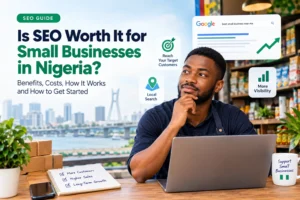
Running a small business in Nigeria is not always easy. Between rising operating costs, competition, customer expectations, and the money required to promote your products or services, every business decision matters. You want marketing strategies that can help you reach more customers without wasting your limited budget.
This raises an important question: Is SEO worth it for small businesses in Nigeria?
The short answer is yes, SEO can be worth the investment if your potential customers use search engines to find products, services, or solutions like yours. However, it is not the right first step for every business, and results are not guaranteed.
Search engine optimisation (SEO) helps people discover your business through unpaid search results. Instead of paying for every click, you work on making your website and business information useful, relevant, trustworthy, and easy to find.
In this guide, you will learn how SEO works, its benefits and disadvantages, how much it may cost, how long it takes to see results, and how to get started on a small budget.
Whether you run a fashion business in Lagos, a bakery in Abuja, a plumbing service in Port Harcourt, or an online store serving customers across Nigeria, this guide will help you decide whether SEO is a sensible investment.
Not Sure Whether SEO Is Right for Your Business?
Before investing in SEO, it is worth understanding whether your customers use Google to find businesses like yours, which keywords are relevant to your services, and what improvements your website may need.
If you are considering SEO for your Nigerian business, explore our SEO services to understand the available options. You can also contact us to discuss your website, business goals, and current marketing challenges.
A sensible starting point is to identify the opportunities that matter most to your business, rather than committing to a large marketing budget immediately.
SEO is not about promising instant rankings. It is about building a useful online presence and measuring whether it attracts the right visitors and contributes to business growth.
What Is SEO, and How Does It Work?
SEO stands for search engine optimisation. It involves improving your website and online presence so search engines such as Google can understand your business and show relevant pages to people searching for what you offer.
For example, imagine you own a catering business in Warri. Someone searches Google for “affordable catering services in Warri.”
If your website clearly explains your catering services, displays your menu or packages, provides contact information, and answers customers’ questions, Google may consider your pages relevant to that search.
When your website appears in unpaid search results, a potential customer can visit it without you paying Google for that particular click.
SEO does not mean tricking Google or repeating keywords everywhere. It means helping search engines understand your content while making it easier for customers to find useful information.
There are four important areas of SEO:
- On-page SEO: Improving page titles, headings, content, images, and links on your website.
- Technical SEO: Making sure search engines can access your website and visitors can use it without unnecessary problems.
- Local SEO: Helping nearby customers discover your business through local search results and Google Maps.
- Off-page SEO: Building your website’s reputation through relevant mentions, genuine recommendations, and links from other trustworthy websites.
These activities work together to improve your chances of being discovered online.
Is SEO Worth It for Small Businesses in Nigeria?
Yes, SEO is worth considering when customers actively search online for your products or services and your business can meet their needs.
One major advantage is that SEO can help you reach people who are already interested in what you offer. Someone searching for “buy Ankara fabric online Nigeria” may have a stronger purchasing intention than someone casually scrolling through social media.
SEO can also help small businesses compete by targeting specific customer needs rather than competing for every possible search term.
For example, a small accounting firm may struggle to rank nationally for a broad phrase such as “accounting services.” However, it could target more specific searches such as “bookkeeping services for small businesses in Benin City.”
This approach allows a business to focus on a particular audience and build visibility around its expertise.
However, SEO is not automatically profitable. Its value depends on your industry, competition, website quality, available budget, customer behaviour, and ability to convert visitors into paying customers.
If your customers rarely use search engines to find your products, or you need immediate sales to cover urgent expenses, other marketing channels may deserve priority.
The best approach is to understand your customers first and then choose the marketing methods that suit them.
Seven Benefits of SEO for Small Businesses in Nigeria
1. SEO Helps Customers Find Your Business Online
Many potential customers search online before choosing a product or service provider. They may compare prices, read reviews, check business locations, or look for examples of previous work.
If your business appears for relevant searches, you have another opportunity to attract those customers.
For example, a photographer in Enugu could publish a useful page about wedding photography packages, explain what each package includes, and show examples of completed projects.
A couple searching for wedding photographers in Enugu could discover that page and contact the photographer.
Without a strong online presence, the same photographer may depend more heavily on referrals and social media posts.
2. SEO Can Reduce Dependence on Paid Advertising
Paid advertising can help businesses attract attention quickly, but advertising campaigns generally require ongoing spending to maintain their reach.
SEO works differently. You invest time and resources in improving your website, publishing helpful content, and strengthening your online presence.
If your pages earn and maintain search visibility, they may continue attracting visitors after the initial work is completed.
However, SEO is not free. Website hosting, content creation, technical improvements, professional assistance, and regular maintenance may all require money.
The advantage is that you are building an online asset that may continue delivering value over time rather than paying for every visit directly.
3. SEO Helps Build Trust and Credibility
Customers want to know whether a business is genuine before spending their money.
A professional website with clear service descriptions, accurate contact details, customer reviews, transparent pricing information where appropriate, and examples of previous work can help customers make informed decisions.
Useful articles can also demonstrate that you understand your industry.
For example, a solar installation company could explain how to choose an inverter, what affects battery life, and which questions customers should ask before paying for an installation.
When your content is accurate, practical, and supported by real experience, it can help establish credibility.
Remember that appearing in Google does not automatically prove a business is trustworthy. Customers still need reasons to believe that you can deliver what you promise.
4. Local SEO Can Attract Nearby Customers
Local SEO is especially valuable for businesses that serve specific cities, neighbourhoods, or communities.
Examples include restaurants, salons, repair services, clinics, cleaning companies, and event planners.
A customer may search for “phone repair in Ikeja” or “bakery near me.” Local search results can help that customer discover relevant businesses nearby.
One useful starting point is your Google Business Profile, which can display information such as your business name, location or service area, opening hours, phone number, photos, and customer reviews.
Eligible businesses can create and manage a profile without paying a listing fee. You should provide accurate information and follow Google’s eligibility rules.
For service-area businesses, use the appropriate service-area settings rather than displaying a residential address that should remain private.
Local SEO can make it easier for potential customers to find your business, contact you, and understand what you offer.
5. SEO Can Attract Customers Who Are Ready to Buy
Not every online visitor has the same intention. Some people want to learn something. Others are comparing providers, checking prices, or preparing to make a purchase.
SEO helps you create content for these different stages. For example:
- “What is solar energy?” targets people seeking information.
- “How much does solar installation cost in Nigeria?” targets people comparing costs.
- “Solar installation company in Abuja” targets people looking for a provider.
By creating relevant pages for these searches, your business can reach people at different stages of their decision-making process. The goal is not simply to attract more visitors. It is to attract visitors who are likely to benefit from your products or services.
6. SEO Can Support Long-Term Business Growth
A helpful article, service page, or product page may attract visitors for months or years if it remains relevant and performs well in search results.
For instance, a fashion retailer could publish a guide explaining how to choose the right fabric for different occasions. That article may attract readers who later explore the retailer’s products.
Over time, a collection of useful pages can create several ways for potential customers to discover the business.
However, search rankings can change as competitors improve their websites, customer needs change, and search engines update their systems. Content should be reviewed and updated when necessary.
SEO is therefore better understood as a long-term marketing investment than a one-time task.
7. SEO Helps You Understand Your Customers
SEO tools can reveal the searches that lead people to your website, the pages they visit, and the content that attracts attention.
These insights can help you understand what your customers want to know before making a decision. For example, if visitors frequently find your website through questions about delivery fees, you may need a clearer delivery policy.
If a service page receives visits but generates few enquiries, you may need to improve its explanation, pricing information, contact options, or trust signals.
This information can help you improve both your marketing and your overall customer experience.
What Are the Disadvantages of SEO?
Although SEO offers useful opportunities, it also has limitations that small business owners should understand.
- SEO takes time: A new website may need several months of consistent work before meaningful improvements become visible. Competitive industries may take longer, and some pages may never achieve their intended rankings.
- Results are not guaranteed: No ethical SEO professional can guarantee that your website will rank first for every keyword. Search engines decide which results to display based on many factors.
- SEO requires ongoing effort: Your competitors may publish better content, your products may change, and your website may develop technical problems. You need to monitor performance and make improvements.
- SEO may not generate immediate sales: Even if visitors arrive at your website, they may leave without contacting you or making a purchase.
Finally, SEO can become expensive if you hire the wrong provider or invest in activities that do not support your business goals. Understanding these limitations helps you set realistic expectations and avoid spending money based on unrealistic promises.
How Much Does SEO Cost in Nigeria?
The cost of SEO in Nigeria varies considerably depending on the size of your website, your industry, the competition, and the amount of work required.
A business owner who handles basic SEO independently may spend little beyond existing website expenses. A business that hires a consultant or agency may pay for keyword research, technical improvements, content production, local SEO, reporting, and ongoing optimisation.
There is no single price that applies to every business. Instead of choosing a service based only on its price, ask what the provider will actually deliver.
A professional SEO proposal should explain:
- The work included in the service.
- The pages or business locations being targeted.
- The content and technical improvements planned.
- How progress will be measured.
- How often performance reports will be provided.
- Which costs are additional to the agreed fee.
Be cautious of providers who promise instant rankings, guaranteed first positions, or thousands of backlinks without explaining how those links will be earned.
Cheap services can become expensive if they waste months of your time or damage your website’s reputation. For a small business, a limited project with clear deliverables may be a better starting point than committing immediately to an expensive monthly package. SEO costs depend on the work your website needs, the competition in your market, and the services included in your agreement. For a more detailed breakdown, read our guide to SEO costs in Nigeria
How Should a Small Business Budget for SEO?
If your business has a limited marketing budget, start by identifying the biggest obstacles to being found online.
For one business, the priority may be fixing technical problems that prevent important pages from appearing in Google. For another, it may be creating a useful service page, improving its Google Business Profile, or explaining its services more clearly.
Before hiring an SEO professional, ask for a clear list of priorities and deliverables. You should understand what will be done, why it matters, how progress will be measured, and which costs are separate from the agreed fee.
You can begin with a defined project before deciding whether ongoing SEO support is necessary.
The right budget is one your business can sustain while still meeting its operating expenses. Avoid borrowing money or making financial commitments based on promises of guaranteed rankings or sales.
How Long Does SEO Take to Work?
SEO does not usually produce instant results because search engines need to discover, understand, and evaluate your website and its content. The timeline depends on your website’s current condition, competition, content quality, technical issues, and the resources available for improvement.
During the first few weeks, you might focus on fixing website problems, researching keywords, improving page titles, and setting up measurement tools.
Over the following months, you may begin to see changes in search impressions, rankings, website visits, or customer enquiries. Meaningful business results may take several months or longer, particularly for new websites and competitive search terms.
These are general expectations, not guaranteed milestones. Some improvements happen sooner, while others take much longer. Do not judge SEO only by whether you have reached the first page of Google. Monitor several indicators, including:
- Whether your important pages are appearing in search results.
- How many relevant visitors reach your website.
- Which search terms attract those visitors.
- How many visitors contact your business.
- How many enquiries become paying customers.
- Whether the revenue generated justifies the investment.
The most important result is not a ranking by itself. It is whether your marketing contributes to your business goals.
How to Start SEO for Your Small Business in Nigeria
You do not need to implement every SEO technique at once. Start with the basics and improve your website gradually.
Step 1: Identify What Your Customers Search For
Begin by listing the products or services you offer and the questions customers frequently ask.
Think about how an ordinary person would describe the problem they want to solve.
For example, a customer may search for “affordable website designer in Lagos” rather than a technical phrase such as “responsive website development solutions.”
Use Google autocomplete, related search suggestions, and keyword research tools to discover possible search terms.
Choose phrases that match your services and the needs of your intended customers. Do not assume that a keyword is popular simply because it sounds important.
Step 2: Create Useful Website Pages
Your website should clearly explain what you sell, who you serve, and how customers can contact you.
Create separate pages for important services or product categories when each deserves its own detailed explanation.
For example, a cleaning company might have pages for residential cleaning, office cleaning, and post-construction cleaning.
Include relevant details, answer common questions, and make it easy for visitors to take the next step.
Avoid publishing several nearly identical pages simply to target different keywords.
Step 3: Improve Your Website for Mobile Users
Many customers browse websites using smartphones. Your pages should therefore be easy to read and use on smaller screens.
Check that text is readable, buttons are easy to tap, contact details are accessible, and images do not make the website unnecessarily slow.
A fast, usable website improves the visitor experience and helps search engines access your content more effectively.
Step 4: Set Up Google Business Profile
If your business is eligible, create or claim your Google Business Profile and verify it.
Provide accurate business information, choose relevant categories, upload genuine photos, and keep your opening hours updated.
Encourage real customers to leave honest reviews, and respond professionally to feedback.
Never buy fake reviews or offer rewards in exchange for reviews in ways that violate the platform’s policies.
Step 5: Publish Helpful, Original Content
Create articles that answer genuine questions from your customers.
A bakery could write about choosing a cake size for different events. A mechanic could explain warning signs that a car needs servicing. A Nigerian clothing retailer could publish a guide to choosing fabrics for different occasions.
Your content should be accurate, easy to understand, and based on reliable information or relevant experience.
You do not need to publish an article every day. A smaller collection of genuinely helpful pages is more valuable than a large number of repetitive articles.
Step 6: Measure Your Progress
Set up Google Search Console to monitor how your website performs in Google Search. It can help you understand search impressions, clicks, and indexing issues.
You can also use Google Analytics to understand website visits and measure important actions, such as enquiry submissions or purchases, when properly configured.
Review your data regularly and use it to identify what needs improvement.
Is SEO Better Than Social Media Marketing?
SEO and social media marketing serve different purposes, so one is not automatically better than the other.
Social media can help you introduce your products to people who were not actively looking for them. It can also support community building, product demonstrations, conversations, and customer relationships.
SEO helps your business become discoverable when people search for information, products, or services. For example, a Nigerian skincare brand could use Instagram to demonstrate how its products are used while publishing website articles that answer customers’ questions about product ingredients and routines.
Both channels can support the same customer journey. If your business needs immediate visibility, social media promotion or paid advertising may be useful while you build your search presence. If customers regularly search for what you sell, SEO may become an important long-term channel.
Choose based on your audience, goals, resources, and results rather than following trends.
SEO, GEO, and the Future of Online Discovery
Search behaviour is evolving. People increasingly encounter information through AI-powered search features and conversational tools, in addition to traditional search results.
This has led to growing interest in Generative Engine Optimisation (GEO), a term used for improving the chances that useful, credible information about a business will be discovered or referenced by generative AI systems.
Although GEO practices and their impact are still developing, small businesses can take sensible steps to improve the quality and clarity of their online information.
Publish original, factual content. Explain your services clearly. Keep business details consistent. Include relevant examples, qualifications, author information, and references where appropriate.
For instance, a Nigerian logistics company could publish a clear guide explaining its delivery areas, collection procedures, delivery limitations, and customer support process. This information can help both people and automated systems understand the business.
However, no GEO technique guarantees that an AI system will mention your brand. Focus first on creating useful information, maintaining a trustworthy website, and ensuring that search engines can access your pages.
How to Measure Whether SEO Is Worth the Cost
The best way to judge SEO is to measure the business results it contributes to, rather than focusing on rankings alone. Start by recording how much you spend on SEO, how many relevant enquiries come from organic search, how many enquiries become customers, and how much profit those customers generate.
For example, imagine a small business spends ₦100,000 on SEO in a month. It receives 20 enquiries from organic search, and four of those enquiries become customers. In this illustration:
- SEO spending: ₦100,000
- Organic-search enquiries: 20
- Customers acquired: 4
- SEO cost per enquiry: ₦5,000
- SEO cost per acquired customer: ₦25,000
Important: Cost per acquired customer tells you how much you spent to acquire each customer; it does not tell you whether that customer was profitable. Compare acquisition costs with the profit remaining after relevant product, delivery, service, staffing, and other operating expenses. Where possible, account for repeat purchases and the time required to recover your marketing investment.
These figures are hypothetical. They do not establish that SEO will produce the same results for another business. The next question is whether the profit from those four customers is enough to justify the SEO investment. Account for product or service delivery costs, staff time, and other relevant expenses before drawing a conclusion.
Use Google Search Console to monitor search visibility and clicks. Where practical, track enquiry forms, phone calls, WhatsApp leads, and sales so you can assess which marketing activities are contributing to business growth.
Remember that some customers may discover you through Google and complete their purchase through another channel. Keep your attribution assumptions realistic. SEO is worth continuing when the evidence suggests that it contributes meaningful business value and the cost is sustainable for your business.
Frequently Asked Questions About SEO for Small Businesses in Nigeria
Can I do SEO myself without hiring an expert?
Yes. Many small business owners can handle basic keyword research, content improvement, Google Business Profile management, and performance monitoring themselves. More complicated technical problems or highly competitive markets may require professional support.
Is SEO free in Nigeria?
Organic search listings do not require payment to Google for each click. However, doing SEO can involve expenses such as hosting, website development, content creation, tools, and professional services.
Can SEO help a business without a website?
Yes, to some extent. Eligible local businesses can use Google Business Profile and other legitimate online listings to improve their visibility. However, a website gives you greater control over your content, service information, and customer journey.
Is SEO suitable for a new business?
Yes, provided your potential customers use search engines to discover businesses like yours. A new business can start with local visibility, a clear website, and specific keywords that reflect its products or services. It should still consider other marketing channels while building its search presence.
Can SEO guarantee first-page rankings?
No. Search rankings depend on many factors, and no provider can legitimately guarantee a particular position for every keyword. A professional should explain the work being done, the risks involved, and how performance will be measured.
Author Profile

-
James Agbai is an SEO Specialist and Content Strategist with over five years of experience helping businesses, bloggers, startups, and service providers improve their online visibility through ethical, data-driven SEO.
He specializes in technical SEO, content strategy, keyword research, and on-page optimization, with a focus on building sustainable organic growth rather than relying on short-term tactics.
Latest entries
 SEO for Nigerian BusinessesOctober 31, 2026How to Build an SEO Strategy on a Small Business Budget: A Complete Beginner’s Guide
 SEO for Nigerian BusinessesOctober 31, 2026SEO vs. Paid Advertising for Nigerian Small Businesses: Which Is Better for Growing Your Business?
 SEO for Nigerian BusinessesOctober 29, 2026How to Choose an SEO Agency in Nigeria: A Complete Guide for Businesses
 SEO for Nigerian BusinessesOctober 29, 2026Is SEO Worth It for Small Businesses in Nigeria? A Complete Guide