
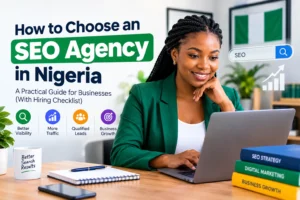
Choosing the right SEO agency in Nigeria can make a significant difference in how people discover your business online. Whether you own a small business in Lagos, run an online store in Abuja, manage a professional service in Port Harcourt, or operate a growing company elsewhere in the country, search engine optimisation (SEO) can help you reach potential customers when they are searching for products or services like yours.
However, choosing an SEO company is not always easy. Many agencies promise first-page Google rankings, more website traffic, and increased sales. Some deliver meaningful results, while others use outdated techniques, provide little transparency, or focus on rankings without considering whether those rankings generate customers.
So, how do you choose an SEO agency in Nigeria that understands your business, works within your budget, and supports your long-term growth?
This guide explains what to look for in an SEO agency, the questions to ask before hiring one, the services you may need, and the warning signs to avoid. By the end, you should have a practical framework for choosing an SEO partner with confidence.
Ready to Improve Your Website’s Google Rankings?
Choosing the right SEO strategy starts with understanding your business goals. Explore your website’s SEO opportunities and identify practical steps to improve your online visibility and attract potential customers.
1. Understand Your Business Goals Before Hiring an SEO Agency
Before contacting any SEO company in Nigeria, identify what you want SEO to achieve for your business.
SEO is not simply about appearing on the first page of Google. The real objective is to attract relevant visitors who are likely to become customers, clients, subscribers, or qualified leads.
For example, a fashion retailer may want more people to discover its products through Google. A law firm may want enquiries from people searching for legal services in its city. A hotel may want more direct bookings, while a software company may want to attract businesses looking for its solutions.
These goals require different SEO strategies. Start by asking yourself the following questions:
- Do I want more visitors to my website?
- Do I need more enquiries, phone calls, or sales?
- Am I targeting customers in one Nigerian city or across the country?
- Do I want to reach customers in other African countries or international markets?
- Is my website new, or does it already receive organic traffic?
- Which products or services generate the most revenue for my business?
Your answers will help you choose an agency that understands your objectives. For instance, a business serving customers in Lagos may need local SEO, while an e-commerce business selling nationwide may require technical SEO, product-page optimisation, and content marketing.
Practical tip: Write down two or three measurable business goals before requesting proposals. This makes it easier to compare agencies based on the value they can potentially deliver rather than impressive sales presentations.
Not Sure Which SEO Service Your Business Needs?
Every business has different SEO requirements. Before committing to a package, compare your website’s needs, budget, and growth objectives to find an approach that makes sense for your business.
2. Check the Agency’s SEO Experience and Track Record
One of the most important factors when choosing an SEO agency in Nigeria is its ability to demonstrate relevant experience.
An agency may have an attractive website and persuasive marketing materials, but these alone do not prove that it can manage your SEO campaign successfully.
Look for evidence of previous work, including case studies, client testimonials, project examples, and explanations of the strategies used.
A useful case study should explain the client’s original problem, the work completed, the period covered, and the results achieved. For example, an agency might describe how it improved the visibility of a service business by fixing technical issues, creating useful landing pages, and targeting relevant search terms.
Pay attention to whether the results are meaningful to your business. An increase in website traffic is encouraging, but it is more valuable when the visitors are relevant and contribute to enquiries, sales, or other business objectives.
When reviewing an SEO agency’s experience, consider these questions:
- Has it worked with businesses in my industry?
- Can it explain the SEO problems it solved?
- Does it measure conversions as well as traffic?
- Can it provide references or verifiable examples where appropriate?
- Does it explain what contributed to the reported results?
- Are its case studies realistic and specific?
An agency does not necessarily need experience in your exact industry to be effective. Strong technical knowledge, sound research, and a clear understanding of your audience can also be valuable. However, it should be able to explain how it will learn about your market and develop a strategy suited to your business.
3. Evaluate the SEO Services Offered
Not every business needs every SEO service. The right combination depends on your website, competition, industry, and growth objectives.
Before hiring an SEO company in Nigeria, understand the services it provides and how they support your goals.
Technical SEO
Technical SEO focuses on making it easier for search engines to access, understand, and index your website.
Common activities include identifying crawling and indexing problems, improving site structure, reviewing redirects, fixing broken links, and addressing website performance issues.
For example, if important product pages cannot be indexed by Google, potential customers may struggle to find them through search results. A competent SEO agency should be able to identify such problems and explain which fixes are most important.
On-Page SEO
On-page SEO involves improving individual website pages so that their content is useful to visitors and relevant to the searches they want to appear for.
This may include improving page titles, headings, meta descriptions, internal links, image descriptions, and the organisation of information. An agency should also help ensure that each important page serves a clear purpose and answers the questions potential customers are likely to ask.
Keyword Research
Keyword research identifies the words and phrases people use when searching for information, products, or services.
For example, a business offering website optimisation services may target phrases such as “SEO agency in Nigeria”, “SEO services in Lagos”, or “how to improve website rankings”.
The best keywords are not always those with the highest search volume. Their relevance, competition, commercial value, and alignment with your services matter too. An experienced agency should explain why it selects particular keywords and how they fit into your overall content strategy.
Content Marketing
Content marketing involves creating useful information that attracts and helps your target audience.
Depending on your business, this may include blog posts, service pages, buying guides, frequently asked questions, comparison articles, and case studies.
High-quality content should address genuine customer needs rather than repeat keywords unnecessarily.
For a Nigerian business, useful content may also answer questions about local pricing, service availability, delivery arrangements, regional needs, or the process of buying a particular product or service.
Local SEO
Local SEO helps businesses improve their visibility in location-based searches.
It is especially useful for restaurants, clinics, hotels, professional service providers, retail shops, and other businesses that serve customers in specific areas.
Local SEO may include improving your Google Business Profile, maintaining accurate business information, earning genuine customer reviews, and creating relevant location pages.
If customers search for services near them, these activities can help your business become easier to discover.
Link Building and Digital PR
Links from relevant, trustworthy websites can help search engines discover content and understand relationships between websites.
Ethical link-building activities may include publishing original research, earning mentions from reputable publications, building industry relationships, and creating resources that other websites genuinely want to reference.
Be cautious of agencies that promise hundreds of backlinks for a very low price without explaining their sources or methods.
The quality and relevance of links matter more than simply accumulating large numbers.
4. Choose an Agency That Understands the Nigerian Market
An SEO agency working with Nigerian businesses should understand the market in which those businesses operate.
This includes local search behaviour, regional competition, customer expectations, and the practical differences between serving customers in one city and serving customers nationwide.
For example, a business targeting customers in Lagos may need to optimise for searches related to specific neighbourhoods or services available in the city. A company selling products across Nigeria may need a different strategy that addresses delivery locations, product availability, and customer questions from multiple states.
The agency should also understand how your customers make purchasing decisions.
Some customers compare prices before contacting a provider. Others look for reviews, professional qualifications, delivery information, or evidence that a business is trustworthy.
Your SEO strategy should address these needs through relevant pages and helpful content.
However, do not assume that an agency must be physically located in your city to understand your audience. A remote agency can deliver excellent work if it conducts proper research, communicates effectively, and demonstrates relevant knowledge.
During your initial conversation, ask how the agency plans to research your customers, competitors, and target locations. Its answer should be specific to your business rather than a generic explanation that could apply to any company.
5. Ask How the Agency Measures SEO Success
SEO results should be measured using meaningful data rather than vague claims. Before signing an agreement, find out which performance indicators the agency will track and how often it will report progress.
Common SEO metrics include:
- Organic traffic: Visitors who arrive through unpaid search results.
- Keyword visibility: How often and where your website appears for relevant searches.
- Click-through rate: The percentage of search-result impressions that generate clicks.
- Conversions: Valuable actions such as purchases, form submissions, calls, or bookings.
- Qualified leads: Enquiries that are relevant to your business and potential sales.
- Revenue contribution: Sales or revenue that can reasonably be attributed to organic search.
The right metrics depend on your objectives. For example, an online shop should pay close attention to organic sales and revenue, while a consultancy may prioritise qualified enquiries and booked appointments.
An agency should establish a baseline before work begins. This provides a reference point for evaluating changes over time.
It should also explain that SEO performance can fluctuate because of competition, website changes, search engine updates, seasonality, and other factors.
No reputable agency can guarantee a specific Google ranking or promise that every SEO activity will produce immediate results.
Instead, look for a company that uses reliable measurement, explains its decisions, and adjusts the strategy when evidence suggests that changes are needed.
6. Understand SEO Pricing in Nigeria
SEO pricing in Nigeria varies considerably. The cost depends on the agency’s experience, the scope of work, the competitiveness of your industry, the condition of your website, and the amount of support required.
Some businesses need a limited technical audit and a list of recommendations. Others require ongoing technical improvements, content production, local SEO, digital PR, and conversion tracking.
These are different projects and should not be expected to cost the same amount.
Rather than selecting the cheapest provider automatically, compare what each proposal includes. A clear SEO proposal should explain:
- The services included in the package.
- The number and type of pages to be reviewed or improved.
- Whether content writing is included.
- Whether technical implementation is included or billed separately.
- How reporting and communication will work.
- The contract duration and payment terms.
- Any additional costs that may arise.
Request proposals from at least two or three suitable providers if practical. Compare the scope, deliverables, expertise, and expected workload rather than looking at the monthly fee alone.
A low-cost package may be suitable for a small project with limited requirements. However, a package that promises extensive work for an unrealistic price may not provide enough time or expertise to do the job properly.
Likewise, a high price does not automatically mean an agency is good. The goal is to find a provider whose services are appropriate for your budget and whose work can be evaluated against clear business objectives.
7. Look for Transparency and Clear Communication
A professional SEO agency should be able to explain its work in language you understand. You should not need advanced technical knowledge to understand what the agency plans to do, why it matters, and how progress will be assessed.
Before hiring an SEO company, find out who will manage your account, how frequently you will receive updates, and how you can request clarification.
Ask whether you will receive access to relevant tools and reports, including Google Search Console and Google Analytics where appropriate.
Ideally, your business should retain ownership of its website, domain, analytics accounts, and other essential digital assets.
The agency may need permission to access these systems, but you should understand who controls them and how access can be transferred if the relationship ends.
A useful monthly report should explain the work completed, important changes in performance, outstanding issues, and the next steps. It should not simply present graphs without interpreting what they mean for your business.
Good communication also includes honest conversations about setbacks. If a strategy is not working as expected, the agency should explain what it has learned and what it recommends doing next.
8. Check Whether the Agency Follows Google’s SEO Guidelines
SEO methods can affect your website’s long-term visibility and reputation. Some agencies use manipulative techniques to pursue quick results. These may include buying links intended to manipulate rankings, generating large amounts of low-value content, or using other tactics that violate search engine spam policies.
Such approaches can expose a website to ranking losses or other search-related problems. Ask prospective agencies how they approach link building, content creation, technical optimisation, and search engine guidelines.
A trustworthy agency should prioritise useful content, sound technical practices, relevant links, and a good experience for visitors. It should also be willing to explain the risks associated with particular tactics.
Be especially careful if an agency promises hundreds of backlinks overnight, recommends hiding text from users, or suggests publishing large volumes of nearly identical pages simply to target different keywords.
Automation and artificial intelligence can support research and content workflows, but using these tools does not remove the need for accuracy, originality, editorial review, and genuine value.
The key question is not whether an agency uses particular tools. It is whether its methods produce useful, trustworthy work that supports your business without relying on search manipulation.
9. Evaluate the Agency’s Approach to EEAT and Content Quality
EEAT stands for Experience, Expertise, Authoritativeness, and Trustworthiness. These are concepts used in Google’s search quality evaluation framework to help assess the quality of content and websites.
EEAT is not a single ranking factor that an agency can switch on. Rather, it provides a useful way to think about whether your website demonstrates credibility and offers dependable information.
A good SEO agency should help your business communicate why customers can trust you. Depending on your industry, this may involve:
- Publishing accurate, well-researched articles.
- Including author biographies where appropriate.
- Showing relevant qualifications or professional experience.
- Providing clear business contact information.
- Publishing genuine customer testimonials with permission.
- Explaining products, services, pricing, and policies honestly.
- Updating outdated information.
- Supporting important claims with reliable sources.
For example, a financial services website should be particularly careful about accuracy, professional credentials, and the potential consequences of misleading advice.
An e-commerce website should provide clear product descriptions, delivery information, return policies, and customer support details. Ask the agency how it will demonstrate your business’s real experience and expertise instead of simply adding keywords to existing pages.
The objective is to help visitors make informed decisions and give search engines a clearer understanding of your website’s purpose and credibility.
10. Ask About GEO and AI Search Visibility
Search behaviour is changing as people increasingly use AI-powered search experiences and conversational assistants to research products, compare services, and find answers.
Generative Engine Optimisation (GEO) refers to efforts to improve how a brand’s information can be discovered, understood, and potentially referenced in AI-generated answers.
Although GEO has attracted growing interest, it should not be treated as a guaranteed shortcut to visibility in AI search. There is no reliable promise that a particular content format will make your business appear in every AI-generated response.
Instead, ask whether the SEO agency can help your website provide clear, accurate, accessible, and useful information that serves both traditional search and AI-assisted discovery.
Practical activities may include:
- Creating well-structured pages that answer specific questions.
- Explaining your services, location, expertise, and business identity clearly.
- Publishing original insights, examples, and case studies.
- Using descriptive headings and logically organised content.
- Keeping important business information consistent across reputable sources.
- Implementing appropriate structured data where useful.
- Monitoring available referral traffic and brand visibility indicators.
For example, an agency working with a Nigerian accounting firm might create detailed pages explaining its services, the types of clients it supports, and common questions about its professional offerings.
This can make the website more useful to potential customers, regardless of whether they arrive through a traditional search result or an AI-assisted experience.
Be cautious of agencies that guarantee placement in ChatGPT, Google AI Overviews, or other AI-generated answers. Visibility depends on factors outside any agency’s direct control.
11. Compare an SEO Agency, Freelancer, and In-House SEO Specialist
Hiring an agency is not the only option. Depending on your business size and needs, a freelancer or in-house specialist may be more suitable.
An SEO agency can provide access to different skills, such as technical SEO, content strategy, analytics, and link building. This can be helpful when a project requires several types of expertise.
A freelancer may offer more direct communication, flexibility, and a lower overall cost for a clearly defined project. However, one person may not have the time or expertise to manage every aspect of a complex campaign.
An in-house SEO specialist works within your business and can develop a deeper understanding of your products, customers, and internal processes. The trade-off is the cost of employment and the possibility of needing additional specialists.
Consider the following factors when deciding:
| Option | May be suitable for | Main consideration |
|---|---|---|
| SEO agency | Businesses needing several SEO skills | Check the team, deliverables, and account management |
| SEO freelancer | Small businesses or focused projects | Confirm availability and specialist expertise |
| In-house specialist | Businesses with ongoing SEO needs | Consider salary, tools, and additional support |
There is no universally best option. Choose the arrangement that matches your workload, budget, internal resources, and long-term plans.
12. Warning Signs to Watch for Before Hiring an SEO Agency
Before signing a contract, look for signs that a provider may not be a suitable partner.
The following warning signs deserve attention.
- Guaranteed first-page rankings: No agency controls Google’s ranking decisions. Guaranteed positions for specific competitive keywords should be treated with caution.
- Unusually vague proposals: If the provider cannot explain what it will do, what you will receive, or how it will measure progress, you may struggle to evaluate its performance.
- No evidence of previous work: An agency does not need to reveal confidential client information, but it should be able to demonstrate its capabilities through suitable examples or explanations.
- Unclear link-building methods: Ask where links will come from and why those sources are relevant. Avoid providers that rely on undisclosed, manipulative schemes.
- No access to your data: Your business should retain appropriate ownership and access to its digital assets and performance data.
- Pressure to sign immediately: A professional provider should allow you reasonable time to review the proposal, understand the terms, and ask questions.
- Guaranteed sales or instant results: SEO takes time, and outcomes depend on your market, competition, website, and implementation. Promises of certain revenue or immediate rankings are unreliable.
One warning sign does not always prove that an agency is dishonest, but several together should prompt you to investigate further.
13. Questions to Ask Before Hiring an SEO Company in Nigeria
Before making your final decision, arrange a consultation with each shortlisted agency. Use the conversation to understand its strategy, experience, communication style, and suitability for your business. Here are useful questions to ask:
- How will you assess my website before recommending a strategy?
- What are the main SEO opportunities you see for my business?
- Which services will you provide, and what is excluded?
- Have you worked with similar businesses or target markets?
- How will you measure leads, sales, and other meaningful outcomes?
- What tools and reports will you use?
- How often will we review progress?
- Who will carry out the work and manage communication?
- How do you approach link building and content quality?
- What happens if I decide to end the agreement?
- Will I retain ownership of my website and digital accounts?
- What challenges or limitations do you anticipate?
Pay attention to the quality of the answers, not just the confidence with which they are delivered.
A strong agency should ask questions about your business, customers, competition, website, and commercial objectives before recommending a solution. If it proposes a large package without understanding your needs, it may be prioritising a sale over a suitable strategy.
14. How Long Does SEO Take to Produce Results?
SEO is a long-term investment, not an instant marketing solution. The time required to see meaningful improvements depends on several factors, including your website’s current condition, the competitiveness of your target keywords, the quality of your content, your website’s authority, and how quickly recommended changes are implemented.
Some improvements, such as correcting an indexing problem, may have an impact sooner than a campaign targeting highly competitive commercial keywords. However, even technical fixes do not guarantee immediate ranking changes.
A useful starting point is to establish baseline performance, fix significant technical issues, improve important pages, and monitor progress consistently.
Over time, the agency should be able to explain whether the work is improving visibility, attracting relevant visitors, and contributing to your business objectives.
Avoid judging an entire SEO campaign by a few days of performance or one keyword position. Look at trends over an appropriate period and consider the commercial value of the traffic being attracted.
A reputable agency should provide realistic expectations without guaranteeing a specific timeline or outcome.
Frequently Asked Questions About Choosing an SEO Agency in Nigeria
How do I choose the best SEO agency in Nigeria?
Start by identifying your business goals, then compare agencies based on relevant experience, service quality, transparent pricing, communication, reporting, and ethical SEO practices. Ask for a clear proposal and assess how well each provider understands your target audience.
The best agency is the one that fits your business needs and can explain how its work supports measurable objectives.
How much does an SEO agency charge in Nigeria?
SEO costs vary according to the provider, project scope, competition, and services required. A technical audit, a local SEO project, and an ongoing national campaign involve different levels of work.
Request detailed proposals from several providers and compare deliverables, expertise, and payment terms before deciding.
Can an SEO agency guarantee first-page rankings on Google?
No agency can reliably guarantee first-page rankings for specific competitive keywords. Google determines search results using systems that businesses and SEO providers do not control.
A professional agency should focus on improving your website’s technical health, relevance, content quality, and ability to attract qualified visitors.
Is local SEO important for Nigerian businesses?
Local SEO can be especially valuable for businesses that serve customers in particular cities or areas. Improving your Google Business Profile, maintaining accurate business information, earning genuine reviews, and creating relevant location pages can support local visibility.
However, the best strategy depends on where your customers are and how they search for your services.
Should I hire a cheap SEO agency?
Price alone does not determine quality. A smaller package may suit a business with limited requirements, but you should understand exactly what it includes.
Compare the proposed work, provider expertise, reporting, and contract terms. Be cautious of extremely cheap offers that promise extensive work or guaranteed rankings without a credible explanation.
What is the difference between SEO and GEO?
SEO generally focuses on improving a website’s visibility in search engine results. GEO, or Generative Engine Optimisation, focuses on improving how information about a business may be discovered, understood, or referenced in AI-generated answers.
The two can overlap because both benefit from clear, accurate, useful information. Neither guarantees visibility in every search or AI experience.
Choose an SEO Partner That Understands Your Business
Choosing an SEO agency in Nigeria requires more than comparing prices or believing promises of first-page rankings. It involves finding a provider that understands your customers, explains its strategy clearly, follows sound SEO practices, and measures progress using meaningful business outcomes.
Start by defining your goals. Review the agency’s experience, assess its technical and content capabilities, examine its pricing, and confirm that you will retain control of your website and important digital assets. Ask direct questions about reporting, ethical practices, EEAT, and AI search visibility before signing an agreement.
Remember that SEO is a continuing process. The right partner should help you make informed decisions, improve your website over time, and build a stronger foundation for online discovery.
Whether you are a small business owner, an e-commerce entrepreneur, or the manager of an established company, take the time to compare your options carefully.
The best SEO agency for your business is not necessarily the biggest or the cheapest. It is the one that understands your goals, provides a credible plan, communicates honestly, and works towards sustainable results.
Let’s Build a Stronger Online Presence for Your Business
Finding the right SEO partner can help your business reach more relevant customers through organic search. If you are ready to improve your website’s visibility, discuss your goals with an SEO professional and explore the next steps for your business.
Author Profile

-
James Agbai is an SEO Specialist and Content Strategist with over five years of experience helping businesses, bloggers, startups, and service providers improve their online visibility through ethical, data-driven SEO.
He specializes in technical SEO, content strategy, keyword research, and on-page optimization, with a focus on building sustainable organic growth rather than relying on short-term tactics.
Latest entries
 SEO for Nigerian BusinessesOctober 31, 2026How to Build an SEO Strategy on a Small Business Budget: A Complete Beginner’s Guide
 SEO for Nigerian BusinessesOctober 31, 2026SEO vs. Paid Advertising for Nigerian Small Businesses: Which Is Better for Growing Your Business?
 SEO for Nigerian BusinessesOctober 29, 2026How to Choose an SEO Agency in Nigeria: A Complete Guide for Businesses
 SEO for Nigerian BusinessesOctober 29, 2026Is SEO Worth It for Small Businesses in Nigeria? A Complete Guide